Mastering Concurrency in Go: Channels vs Mutexes

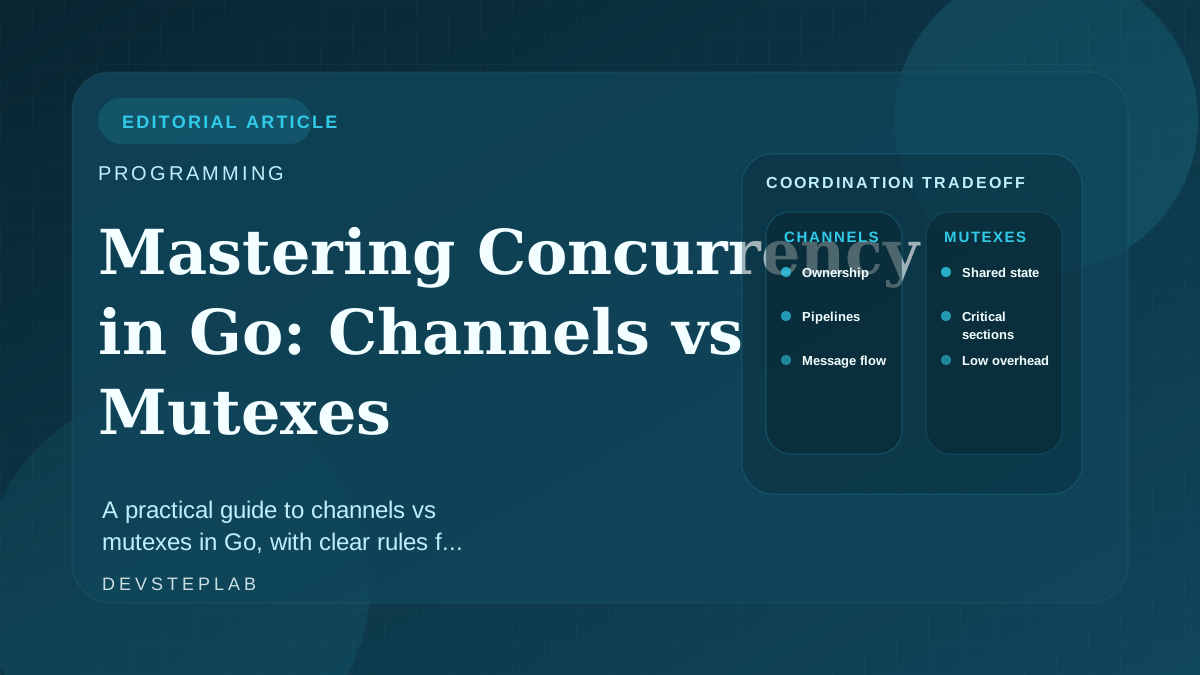
A practical guide to channels vs mutexes in Go, with clear rules for ownership, shared state, throughput, and service-level reliability.
Go treats concurrency as a first-class part of the language. Instead of forcing you to manage operating system threads directly, it gives you goroutines and channels as the default building blocks.
That leads to one of the most common design questions in Go: when should you coordinate with channels, and when should you protect state with a mutex?
If you are deciding between channels and mutexes in Go, optimize for ownership clarity first and only then for raw throughput.
Goroutines: The Foundation
A goroutine is a lightweight unit of concurrent execution managed by the Go runtime. Starting one is as simple as prefixing a function call with the go keyword.
go doSomething() // Runs in the backgroundThat small syntax choice is one reason Go code can express concurrency so directly. The runtime handles scheduling and stack growth behind the scenes.
Channels: Communication
Channels let goroutines exchange values safely without manually sharing ownership of memory.
They work especially well when one part of the system is producing work and another part is consuming it, or when a goroutine needs to hand results back to a coordinator.
Rule of thumb: Reach for channels when the core problem is coordination, ownership transfer, or pipeline flow.
Mutexes: State Protection
Sometimes the problem is simpler. You do not need a communication pipeline. You only need to make sure a shared variable is touched by one goroutine at a time.
That is where sync.Mutex fits.
var mu sync.Mutex
var count int

func increment() {
    mu.Lock()
    defer mu.Unlock()
    count++
}
A mutex is usually the better choice when you are protecting counters, caches, and other shared state that stays in one logical place.
Channels vs Mutexes
The common guidance is still useful:
- Use channels when you are passing work or transferring ownership of data.
- Use mutexes when you are protecting shared state that multiple goroutines need to touch.
Neither tool is universally better. The right choice depends on whether your problem is communication or protection.
Best Practices
Do not leak goroutines
Every goroutine should have a clear path to exit, usually through context cancellation, a closed channel, or bounded worker lifecycle management.
Use the race detector
The -race flag is one of the most practical safety tools in the Go workflow. It helps expose unsafe concurrent access before those issues become production bugs.
Related next reads
Frequently Asked Questions
Is a goroutine the same as a thread?
No. Goroutines are lightweight tasks managed by the Go runtime and multiplexed across a smaller number of operating system threads.
Can I use both channels and mutexes in the same project?
Yes. They solve different problems. Channels are strong for ownership transfer and coordination, while mutexes are strong for protecting shared state.